This post grew out of today’s sermon by Pastor Roderick Webster at Good News Baptist Church in Sint Maarten. I’m grateful for his faithful preaching of God’s Word.
We’re good at grading on a curve. Next to the people in the news, or the neighbor down the street, most of us figure we’re doing fine. Not perfect, but “ok.”
Scripture gives a different picture. Every time someone actually saw God, the curve disappeared.
Isaiah’s “woe”
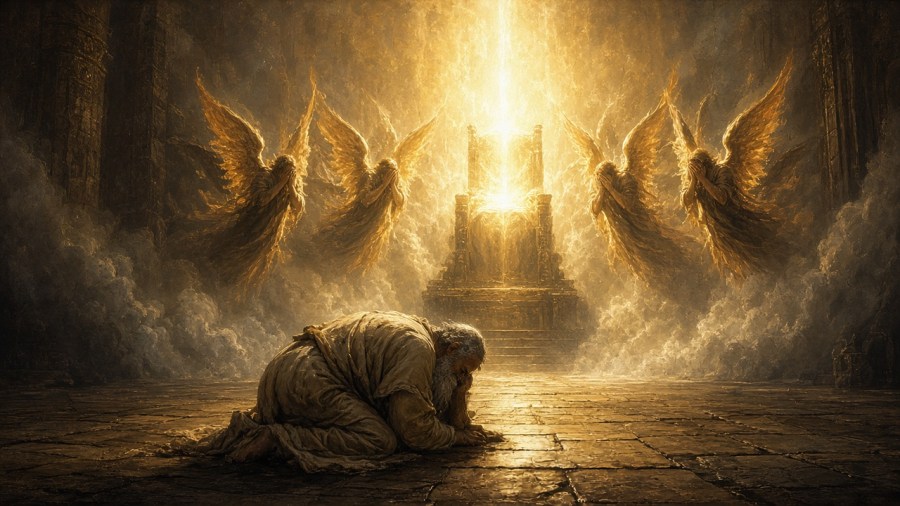
In the year King Uzziah died, Isaiah “saw the Lord sitting upon a throne, high and lifted up” (Isaiah 6:1). Seraphim covered their faces and cried, “Holy, holy, holy is the LORD of hosts; the whole earth is full of his glory!” The temple shook and filled with smoke.
Isaiah was a prophet, probably the most godly man in Judah. He had just spent five chapters pronouncing woes on the nation. But now his first words were “Woe is me! For I am lost; for I am a man of unclean lips… for my eyes have seen the King” (6:5).
The woe wasn’t only for the ungodly. Standing before a holy God, Isaiah saw himself clearly for the first time.
Everyone falls
He wasn’t alone. Moses hid his face at the burning bush. Ezekiel saw the throne above the wheels and fell on his face. Daniel saw the Ancient of Days and later a glorious man, and “no strength was left in me.” Job heard God speak from the whirlwind and said, “I despise myself, and repent in dust and ashes.” At the Transfiguration, Peter, James, and John “fell on their faces and were terrified.” Paul met the risen Christ on the Damascus road and was blinded for three days.
Different centuries, different men, the same response. When you see God’s glory, you don’t stand there admiring it. You go down.
What John saw
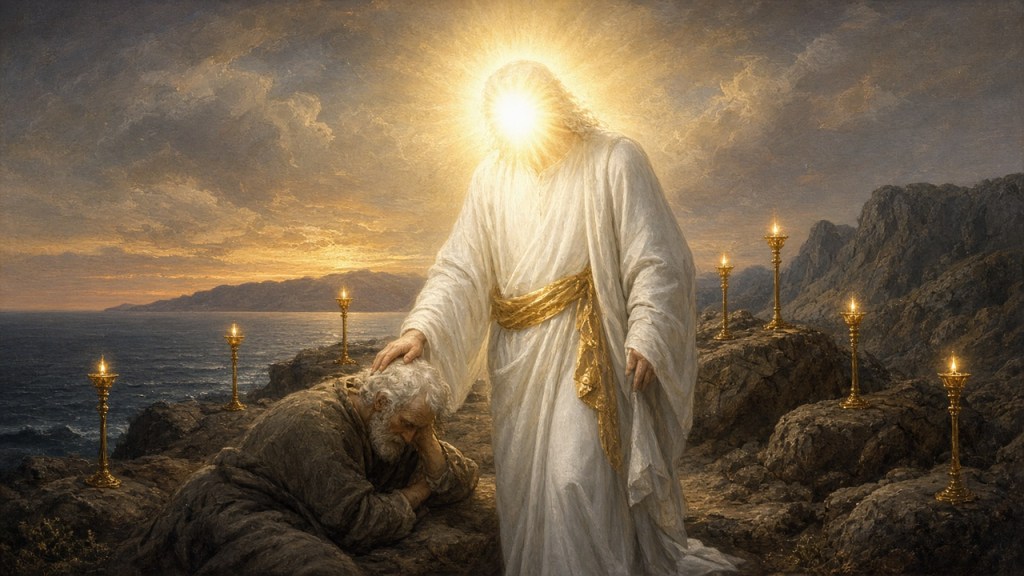
The apostle John saw more of heaven than anyone. He was the disciple Jesus loved, the one who had leaned on His chest at the Last Supper. You might expect him to greet the risen Christ like an old friend.
Instead: “When I saw him, I fell at his feet as though dead” (Revelation 1:17).
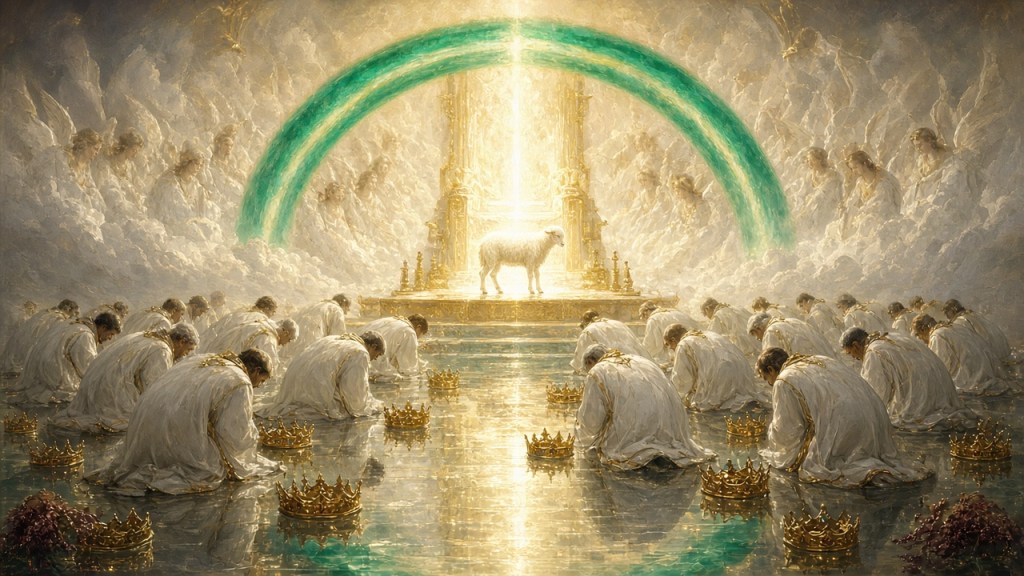
Then John was taken through an open door into the throne room (Revelation 4–5), and what he saw echoes Isaiah and Ezekiel. There is a throne with One seated on it. Around it, living creatures cry “Holy, holy, holy” day and night, the same song Isaiah heard. There is fire, thunder, and a sea of glass like crystal. And the whole scene is about falling down: twenty-four elders cast their crowns before the throne and fall down to worship (4:10). When the Lamb takes the scroll, they fall down again (5:8). Myriads of angels, then every creature in heaven and on earth, join the praise.
Heaven is not a place where people feel good about themselves. Its whole population is face down in worship.
The God we’d rather have
Compare that with how many people approach God today. Some of us have friends, and maybe we’ve been this person ourselves, who aren’t in awe of Scripture, obedience, or God Himself. Their God is a comfortable idea who is all love and acceptance, never judges, and never asks anyone to change. Church becomes an experience to enjoy: a latte, a good band, hands in the air, and a warm sense that God accepts us exactly as we are.
But nobody in Scripture who actually saw God walked away feeling affirmed. Isaiah didn’t hear “you’re fine as you are.” He heard “Holy,” and he fell apart. A God who never makes us tremble is a God we made up (Psalm 50:21). The real God’s love is far greater than that, because it doesn’t leave us as we are. It cleanses us.
The coal and the Lamb
Here’s the good news, and it runs through both visions.
Isaiah didn’t clean himself up. A seraph took a burning coal from the altar, the place of sacrifice, and touched his lips: “Your guilt is taken away, and your sin atoned for” (Isaiah 6:7).
John saw what that altar pointed to. At the center of the throne stood “a Lamb standing, as though it had been slain” (Revelation 5:6). The heavenly song explains why He alone is worthy: “for you were slain, and by your blood you ransomed people for God from every tribe and language and people and nation” (5:9).
The coal on Isaiah’s lips was a preview. The Lamb is the fulfillment. God doesn’t wait for us to become clean enough to approach Him. He provides the sacrifice that makes us clean.
And notice what happens to the people who fall. God doesn’t leave them there. To Daniel: “Fear not.” To the disciples, Jesus touched them and said, “Rise, and have no fear.” To John: “He laid his right hand on me, saying, ‘Fear not, I am the first and the last'” (Revelation 1:17).
Here I am
Once Isaiah was cleansed, God asked, “Whom shall I send?” And the man who had just said “woe is me” answered, “Here I am! Send me” (6:8). John too was lifted to his feet and told, “Write what you see.”
That’s the order of real worship. We see God’s holiness and are humbled. We trust the Lamb’s sacrifice and repent. Then we rise in obedience and go where He sends us. Worship without the “woe” is shallow. A “woe” without the Lamb ends in despair. But a woe answered by the Lamb ends in praise.
So what about us?
If we think we’re “ok,” we haven’t seen Him yet. One day every one of us will. Every knee will bow (Philippians 2:10), either in joy or in dread.
The question isn’t whether we’ll fall down before God. It’s whether we’ll fall down now, in repentance and faith, while the coal is still being offered and the Lamb’s blood still covers sin.
The end of John’s vision tells us where that leads: “They will see his face, and his name will be on their foreheads” (Revelation 22:4). The face that made prophets fall will be the face the redeemed look on forever.
“Holy, holy, holy is the Lord God Almighty, who was and is and is to come!” (Revelation 4:8)

