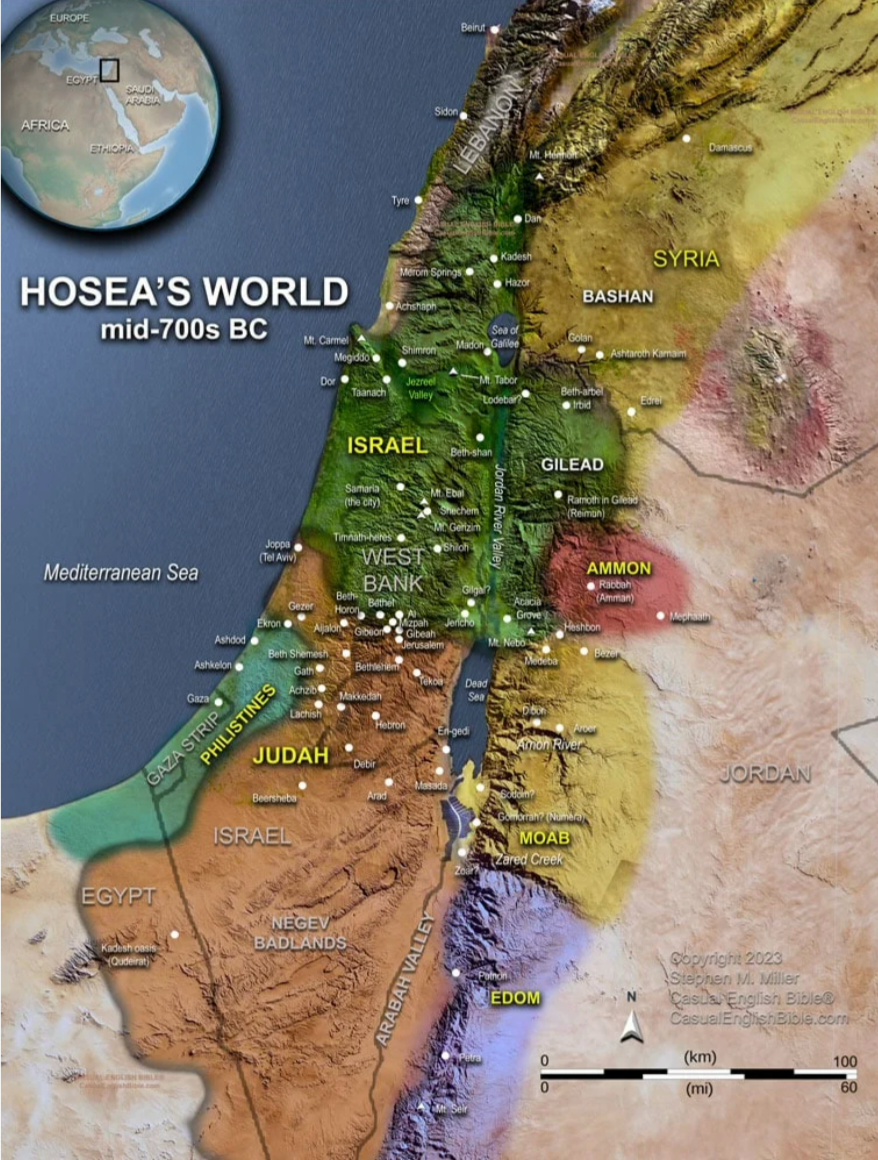
The real danger has never been some evil king sitting on a throne. It’s ordinary people (and rulers) choosing sin over God, generation after generation. When you look at a map of Hosea’s world, his warnings make more sense. Israel’s spiritual problems were tangled up with shaky politics and powerful neighbors. That’s why he kept calling people to stay faithful, turn back, and trust God instead of their own schemes.
Hosea’s Day (mid-8th century BC)
Around 750–722 BC, Hosea spoke to the Northern Kingdom of Israel (sometimes called Ephraim). It was a separate country from the Southern Kingdom of Judah. He told them why judgment was coming, and he also pointed ahead to how God would still love and restore them (especially in chapter 14).
The land was full of prideful people breaking God’s covenant, chasing other gods, treating others unfairly, and playing politics with bigger nations. But God had already told Elijah that He had kept thousands who had not bowed to Baal (1 Kings 19:18). The reality that God preserves a faithful remnant amid apostasy. These weren’t famous people. They were ordinary folks who kept the Sabbath, raised their kids to fear the Lord, and stayed loyal while neighbors offered their children to idols or ran after Assyrian alliances. When Samaria fell in 722 BC, most died, but many of those ordinary households went into exile. It was their quiet faithfulness that kept the knowledge of God alive. He planned it that way.
What Happened Historically
Assyria (722 BC). Assyria wiped out the Northern Kingdom. Most of the remaining people were deported. Foreigners were brought in, and the mixed population that stayed behind became known as the Samaritans. Judah stayed on the map but paid heavy taxes as a vassal state.
Babylon (586 BC). Babylon defeated Assyria. In 586 BC Nebuchadnezzar destroyed Jerusalem and the Southern Kingdom. Most of the people taken to Babylon weren’t prophets like Daniel or Ezekiel. They were families. Jeremiah wrote them a letter: build houses, plant gardens, raise kids, and seek the peace of the city you’re in (Jeremiah 29). Many of them did just that, even while they wept by the rivers of Babylon (Psalm 137).
Persia (539–332 BC). Persia conquered Babylon. Cyrus let some of the Judeans go home. Roughly 42,000 returned—mostly unnamed families (Ezra 2). Zechariah asked, “Who despises the day of small things?” (Zechariah 4:10). What looks insignificant in human eyes is not insignificant to God. The second temple got built because ordinary people gave, worked, and stayed when most had gotten comfortable in Babylon. The completion of the Temple was assured; the “small” day lead to rejoicing when the capstone is set (Zech. 4:7, 10).
The Greek Period and the Hasmoneans (332–63 BC). Alexander the Great took the region in 332 BC. After he died, the area became a buffer zone between rival Greek kingdoms. Later, the Maccabean Revolt produced an independent Jewish state for the first time in centuries. Under the Hasmoneans the borders grew large again.
Roman Rule. Rome took control in 63 BC. After two major revolts (70 AD, when the Second Temple was destroyed, and 132–135 AD), the Romans renamed the province Syria Palaestina and turned Jerusalem into a pagan city. The goal was to erase the Jewish connection to the land – the same goal Islamists have today. But God has bigger plans.
The Christian Era and the Empires That Followed
In the first few centuries after Christ, Christians were a small group, often mistreated. Earlier, Simeon and Anna were elderly ordinary worshipers who recognized the baby Jesus in the temple (Luke 2). Mary and Joseph were a young couple from a nowhere town. The shepherds were just working the night shift. Aftervthe resurrection the early churches met in houses. Lydia sold purple cloth. Priscilla made tents. Most of the people Paul wrote about were unnamed slaves, free people, merchants, and parents who hosted churches, shared meals, and stayed faithful when it cost them something.
Then came the Byzantine period, the early Islamic conquests, the Crusades, the Mamluks, and four centuries under the Ottomans. Empires rose and fell. Rulers came and went—some wise, many cruel, greedy, idolatrous, or simply self-serving. Nations expanded and shrank according to God’s timing, not according to their own strength or wisdom.
The Modern Period (1917–Present)
World War I ended Ottoman control. The British Mandate followed. In 1948 a Jewish state was reborn after nearly two thousand years of diaspora. That is historically extraordinary. Jewish families had kept their culture, identity, language, and hope of return through exile, persecutions, and the Holocaust. Israel has survived wars, absorbed immigrants, and remained a democracy while facing constant security threats, including those that continue into 2026.
How Different Biblical Frameworks Read 1948–Present
People who love the Bible will keep arguing about how much of the modern state of Israel counts as “prophecy fulfilled.” I personally lean premillennial. I see 1948 (and the 1967 capture of the Old City) as important stage-setting or partial fulfillment of prophecies about God bringing the Jewish people back to the land (Ezekiel 36–37, Isaiah 11:11, Amos 9, and others). The return has happened mostly in unbelief, which some passages seem to expect before a later spiritual turning (Zechariah 12:10 and related texts). The ongoing conflict fits the “times of the Gentiles” continuing until God steps in (Luke 21:24).
I also respect the covenant and amillennial view. Those who hold it see modern Israel as historically and humanely significant, but they believe the deepest promises about land and kingdom are fulfilled in Christ, the Church (the true Israel, the olive tree in Romans 11), and ultimately the new creation. They point out that the restoration is still incomplete—no national repentance, no restored Davidic king, no Temple worship in the old sense—and they emphasize Romans 11’s partial hardening and the “fullness of the Gentiles.” You will need to study this to fully understand it. We call these doctrines “the weeds.”
Both sides can agree on this: God is the main actor. The same God who judged and promised restoration in Hosea’s day is still faithful. The precise shape of the ending is still debated. What is not debated is that ordinary people have always been the main way God has carried the story forward. We too often focus on the royal seal on the envelope, not the contents.
The Ordinary People Who Carry the Story
The typical person in every era was not a king, prophet, or general. Most were farmers, mothers, craftsmen, shepherds, merchants, slaves, widows, or soldiers of no rank. Their names are rarely written down. Yet the Bible treats their ordinary faithfulness as the actual means by which God moved the story along. The rulers and empires were the visible surface. The remnant of ordinary people was the substance.
History is full of rulers who lied, judged unfairly, refused to trust God, worshipped idols, chased power and money, and treated people ruthlessly. Nations have come and gone exactly as God allowed. Being small is not a defect. It may actually be a blessing. You don’t have to carry the weight of an empire. You don’t have to pretend you can fix the world through politics. You get to give glory to God in the regular places of life—your home, your work, your neighborhood, your ordinary decisions. And you don’t have to fill mailboxes with mailers to get elected.
C.S. Lewis once pointed out that the most important things often happen away from the spotlight. The 7,000 who did not bow to Baal were not famous. The families who planted gardens in Babylon were not famous. The unnamed people who rebuilt the temple were not famous. The early Christian households that met in homes were not famous. The Jewish mothers and fathers who kept teaching the Shema through centuries of diaspora did not make the history books, yet they are the reason there was still a people in 1948.
Since 1948 the headlines have been about statesmen and wars. The real continuity of the Christian faith has been ordinary people: immigrants who arrived with nothing and built families and farms; parents who kept Jewish or Christian practice when it was unpopular; neighbors who chose simple honesty and hospitality; people who prayed for the peace of Jerusalem and their nations or just lived with integrity at their jobs. Some of the hostages and survivors from recent conflicts have spoken of quiet faith—saying the Shema in a tunnel, thanking God in captivity, returning to ordinary life afterward. That sounds a lot like the psalms written by unnamed sufferers long ago.
I must focus on this now – it is easy to feel too small to matter. But God has always worked through the small and the hidden. Feeling small is not a problem in His story. It is the normal condition of the people through whom the story has always moved. And there is real joy in that. God’s people are not spectators. We are in the middle of God’s plan right now and who wins elections is in His hands. The same God who kept a remnant in Hosea’s day is still keeping one, no matter what political systems rule. Your ordinary faithfulness is not a sideshow. It is part of how God is carrying things forward.
The United States and Ordinary Individuals Today
The United States has been Israel’s most consistent major ally since 1948. That support has been real and consequential. At the same time, the Bible does not name the United States. End-times passages focus on Israel, Jerusalem, the nations, and the Messiah. America is one more nation among “the nations”- significant in the present moment, but not the center of the story. Nations rise and fall according to God’s will. Politics has its place, but history shows how quickly rulers and systems fail when they ignore God.
Your role is not to control the outcome. Romans 9–11 describes a partial hardening on Israel so that Gentiles can come in. Gentile believers are wild branches grafted into the olive tree. That grafting happens by faith in Christ, not by citizenship or political activism.
The typical person today is not a public figure. They are a parent getting kids ready for school, a nurse or teacher or warehouse worker in a manufacturing plant putting in their hours, a neighbor who shows up when someone is sick, a retiree volunteering quietly, a student trying to figure out what is true in a noisy, liberal world. Most of them will never have their name in a history book. Their faithfulness is local and ordinary. And that is enough.
The culture around us is largely secular and fragmented. Religious commitment is considered optional and sometimes treated as a social liability. Screens pull attention in a thousand directions. Institutions are weaker. Political conflict is loud. Comfort brings its own temptations. Against that background, the ordinary faithful person keeps practices the culture does not enjoy or reward: regular prayer or Bible reading that no one else sees, teaching their children a faith the surrounding society does not affirm, showing up for a small church week after week, telling the truth at work when cutting corners is easier, staying in difficult relationships, simply being reliable. They often feel small, me too! Few of us are shaping national policy or prophetic timelines. We are raising one household, influencing a handful of people, and trying to stay faithful. But there is joy in knowing that this is exactly how God has always worked.
God has not switched to working primarily through influencers, governments, or large institutions. The remnant principle still holds true. A minority who remain loyal in their own homes, workplaces, and neighborhoods, even when they feel insignificant, is still how the story moves along. Being small may be a blessing! You get to give glory to God in the regular and remote places of life without the crushing weight of trying to run the world.
The Gospel That Holds It All
The story from Hosea’s judgment on unfaithful Israel, through the long diaspora, the rise of the Church, and the modern return to the land is still unfinished. The precise shape of the ending may be at hand and still debated. But the central invitation is the same, and it is “good news.”
God is holy. We have all sinned and fall short of His glory (Romans 3:23). The wages of sin is death (Romans 6:23). Yet while we were still sinners, Christ died for us (Romans 5:8). He bore the judgment we deserved, rose from the dead, and offers forgiveness and eternal life to everyone who turns from sin and trusts in Him (John 3:16; Romans 10:9–10).
This is the gospel Hosea pointed toward when he spoke of a restored people who would know the Lord. It is the same gospel Paul proclaimed when he wrote about the olive tree. It is the only foundation that makes sense of the long story of judgment and mercy, of ordinary people and extraordinary grace. The political details of 1948–present will be studied carefully. Their precise place in the unfinished story will continue to be argued. But the invitation remains open and joyful: respond to the God of the covenants through the Messiah He has provided. You don’t have to be famous. You don’t have to fix the nations. You get to trust Him, give Him glory in your regular life, and take your place in the story He has written just for you.