
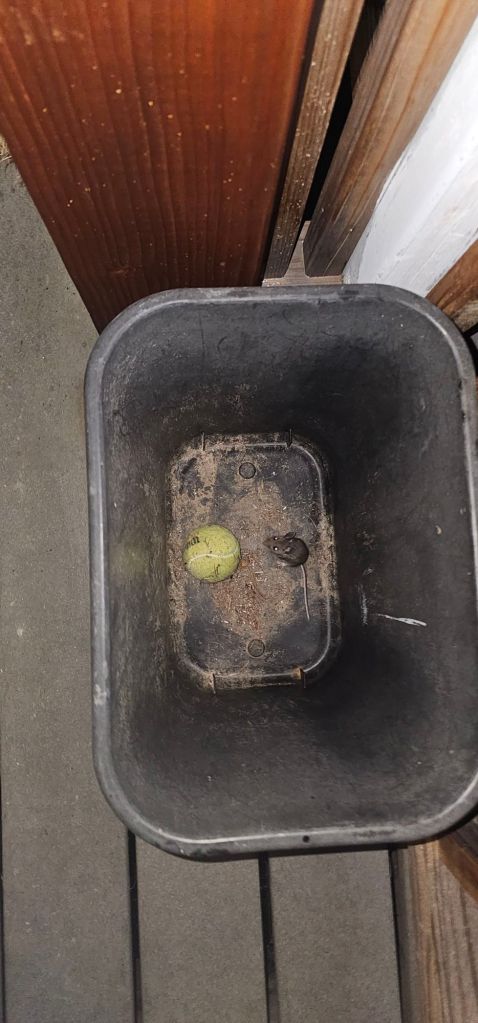
This is a good one! I was studying scripture at 1a.m. and all the while I was hearing noises in the dark outside my bedroom sliding door. My door is open and the screen closed and the night silent – so I can hear even the slightest noise. “This noise sounds odd,” I thought. I got up, turned on the patio light and immediately noticed something with great effort trying to escape from the trash bin on my deck. I only saw flashes of it bounding upwards again and again.
I knew now that it was a field mouse. It had gotten itself stuck inside the bin. It must have surmised or smelled that there was food in the bin and made an effort to get down there to get it. But it calculated wrongly. With each leap it fell short of escape.
Immediately I recognized a striking parallel, and my experience fitting the flow of the very verses I was studying.
I had just been considering 2 Timothy 2:14–15: the warning against “wrangling about words” (useless activity that leads to the “ruin” of the hearers) and the contrasting call to be a diligent “workman” who accurately handles the word of truth, so that he stands approved before God without shame.
The mouse illustrates the first of those two paths with almost painful clarity.
It calculated that there was something desirable in the bin. It made a decisive effort, got itself down into the darkness, and then discovered it had entered a place from which its own strength could not deliver it. Every leap was genuine effort – energetic, repeated, visible – yet every leap fell short. The more it tried in its own power, the more exhausted and trapped it remained. The activity was real; the progress was zero. Left to itself, the end would have been ruin.
That is precisely the picture Paul paints of word-wrangling and empty speculation. People invest real energy in it. They leap again and again – arguing, theorizing, defending positions, chasing clever turns of phrase – yet the effort is “useless” and ultimately destructive. It does not lead upward into light and freedom; it leaves them (and those who listen) stuck in a deeper hole.
The mouse also needed something it could not produce for itself: an outside hand that understood the situation and lowered the rim. Compassion intervened. The same truth runs through the pastoral charge of these verses. The faithful workman does not join the futile leaping. He handles the Word carefully, cuts it straight (“accurately handling”) and becomes the means by which others are lifted out of the trap of error and confusion into the open air of truth.
My own response completed the picture. I did not leave the creature to its exhausted efforts, nor did I crush it. I identified the problem, acted with measured compassion, and set it free. That is the posture of the approved workman: clear-eyed about the danger, diligent in handling the truth, and merciful toward those who have trapped themselves.
So the little drama outside my door was not random. It was a living footnote and miraculous allegory given to the text I was reading – a small, vivid reminder that self-powered striving, even when intense, cannot escape the pit, while accurate handling of the Word (and the mercy that flows from it) can.
But this is not the end of the story.
The mouse is back in the bin. I’m lying on bed writing this and I hear it again, lol.
That changes the parable a little, doesn’t it?
The first time it was a picture of someone who makes a bad calculation, leaps with all his strength, and ends up trapped by his own effort. I lowered the rim, showed mercy, and it ran free. That part still stands as a good illustration of 2 Timothy 2:14–15: the futility of word-wrangling and self-powered striving versus the quiet, accurate work of the one who handles the truth rightly and helps set others free.
But now the same mouse has returned to the same dark container. It has tasted freedom and still chose the place that once held it captive. That adds a deeper layer Scripture often addresses.
Proverbs 26:11 says, “As a dog returns to its vomit, so a fool repeats his folly.” Peter quotes the same idea when he speaks of those who escape the defilements of the world and then become entangled again (2 Peter 2:20–22). There is a stubbornness in the human (and apparently the mouse) heart that can prefer the familiar darkness over the open air, even after deliverance.
In the context of the verses I was studying, this is the tragedy that makes Paul’s charge so urgent. Some people are not merely trapped by accident; they keep going back to the same empty arguments, the same speculative wrangling, the same patterns that already proved useless and ruinous. The workman who accurately handles the word of truth must therefore be both compassionate “and” realistic. Mercy lowers the rim once. Wisdom recognizes that some will climb back in and may need the truth spoken more firmly the next time.
I have already showed kindness once. The second visit is a reminder that freedom offered does not always equal freedom received. The mouse (and the people it now represents) must eventually decide whether the bin is really where it wants to live.
Still, the humor is not lost. There is something almost comical about the persistence and the revelation. Scripture itself sometimes smiles at the absurdity of repeated folly while still calling us to keep handling the Word carefully and without shame.
So as to get some sleep. I will go let the mouse out again and move the garbage bin to a place it can no longer return.
Now I’m thinking of another parable, lol, but I’ll leave that thought and go to bed. We have guests coming tomorrow/today. It wasn’t a grizzly bear story, but I hope you enjoyed my little mouse story, and how God makes reasons for everything. Goodnight.

